Give the gift of knowledge
| Vaccination Liberation - Information | |||
| Legal: | Science: | Misc: | Searches: |
|---|---|---|---|
|
Exemptions State_Chapter/ Resource_Contacts Avoid_Vaccinations Activism LegalNews |
Introduction Basic_Facts Package Inserts Ingredients of Vaccines Q_and_A Artificially Sweetened Times |
Membership Books Videos Tapes 100+ Anti-Vax links Vax_Cartoons News Planned_Events |
KeyWord_Index Search_Our_Site Home_Page Smallpox Alert! |
|
Give the gift of knowledge |
|
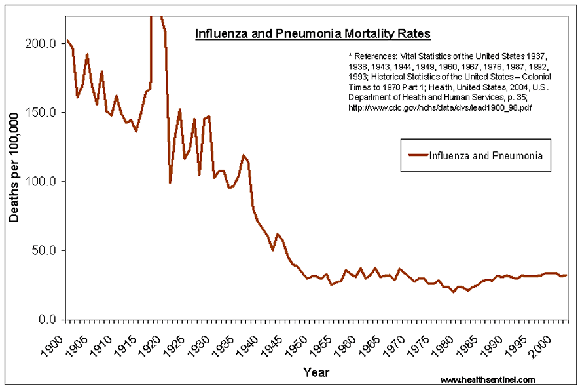
Subject Links: 1918_"Flu" | Adverse Effects | Alzheimer's | Avian_Bird_Flu | Deaths/Graphs | Effective? | FluVax_Fooled? | FluMist® | Flyers/Handouts | General_Information | Graphs | History | Ingredients | Inserts | Legal/Mandates | Flu_News | Prevention | Science | Swine_Flu | Treatment | Vitamins Avian_Bird_Flu | Swine_Flu Please bookmark this page as many of our links go to other sites.Brief Overview:Flu Deaths are only a small percentage of the frequently stated 36,000 deaths per year associated with the flu. The 36,000 is a combined figure for both flu and pneumonia. Flu deaths alone are typically 1 to 4 % of the combined total of 36,000. There are an estimated average of 1250 deaths associated with the flu each year in the USA [1250/36,000= 3.5%]. There is long term, large population evidence that the flu vaccine does NOT save lives in those over 65. Graphs The flu vaccine is NOT effective in any age group at preventing the flu. It is never safe to inject decaying matter mixed with poisons into the human body. See the adverse effects section.
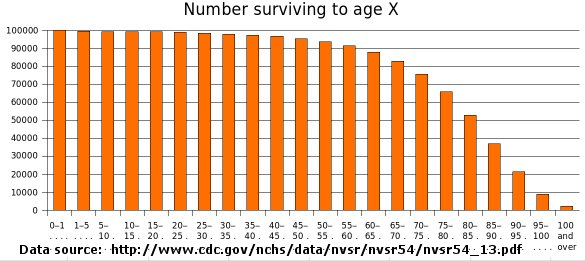
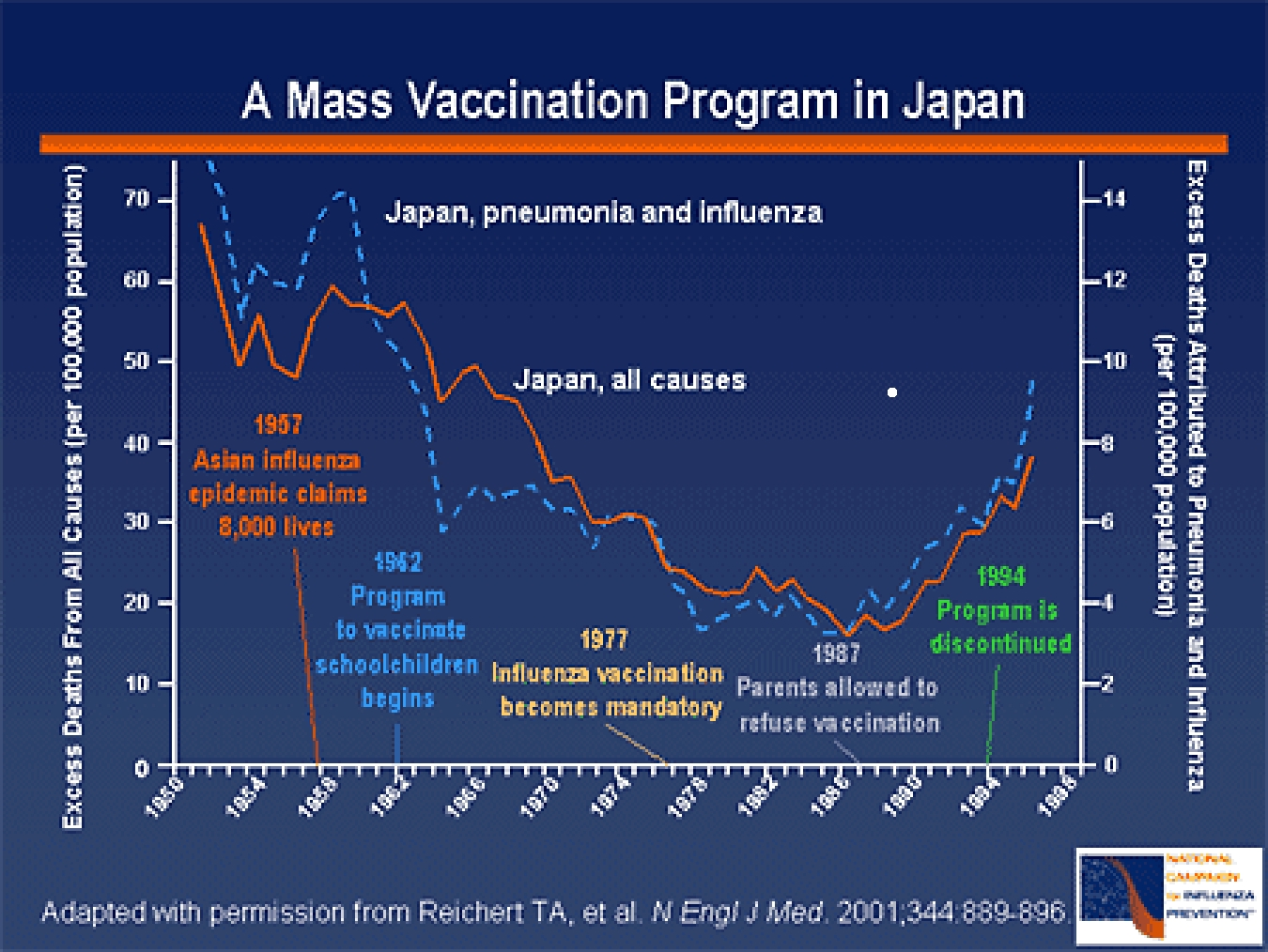
Note: Influenza-related deaths can result from pneumonia and from exacerbations of cardiopulmonary conditions and other chronic diseases. Deaths of adults aged >65 years account for >90% of deaths attributed to pneumonia and influenza. In one study, approximately 19,000 influenza-associated pulmonary and circulatory deaths per influenza season occurred during 1976--1990, compared with approximately 36,000 deaths during 1990--1999. Estimated rates of influenza-associated pulmonary and circulatory deaths/100,000 persons were 0.4--0.6 among persons aged 0--49 years, 7.5 among persons aged 50--64 years, and 98.3 among persons aged >65 years. In the United States, the number of influenza-associated deaths has increased in part because the number of older persons is increasing, particularly persons aged >85 years. In addition, influenza seasons in which influenza A (H3N2) viruses predominate are associated with higher mortality; influenza A (H3N2) viruses predominated in 90% of influenza seasons during 1990--1999, compared with 57% of influenza seasons during 1976--1990. Source of above: http://www.cdc.gov/flu/professionals/diagnosis/ According to CBS News Healthwatch, "But between 1976 and 1999, the number of U.S. adults 85 and older doubled. And the researchers found that this age group was 16 times more likely to die of flu-related causes than people ages 65 to 69."- - - Now what does that have to do with a vaccine? Over half the over 65 population dies, of all causes, between ages 65 and 85. In the 5 years of age between 85-90, 42 percent (a bit less than half) of those who start at 85 will be dead before age 90. Graph of life expectancy for year 2003. Summary The number of over age 65 population went up 40%. The number of over age 85 population doubled. The number of deaths from flu and pneumonia almost doubled. And all that while the percentage of flu vaccinated in this age group went up 330%, thats 3 and 1/3 times. [20 % in 1980 were vaccinated against influenza and now 65-67 % of the over age 65 age group are vaccinated against influenza.] 60 Years of Failing Flu Vaccines Roman Bystrianyk, Jun 02, 2024 ... But just how effective has the influenza vaccine been in practice? Have deaths from influenza declined due to this highly promoted annual vaccination? What do the statistics tell us about the vaccine’s impact on public health? Ingredients
Cell-based Flu VaccinesOn November 20, 2012, the U.S. Food and Drug Administration approved the use of Flucelvax, which is the first U.S.-licensed (trivalent inactivated) influenza vaccine manufactured using cell culture technology. [MDCK = Dog Kidney Cells] http://www.cdc.gov/flu/protect/vaccine/cell-based.htm Do the 2013-2014 seasonal flu vaccines contain thimerosal? The Food and Drug Administration (FDA) has approved several formulations of the seasonal flu vaccine, including multi-dose vials and single-dose units. (See Table of Approved Influenza Vaccines for the U.S. 2013–2014 Season.) ... some of the vaccine is produced in multi-dose vials, and contains thimerosal...
History:
Yes, this year's flu vaccine contains mercury. [2006-2007] And again [2007-2008] http://www.putchildrenfirst.org/flu.html "PutChildrenFirst commissioned a survey by Zogby International of more than 9,000 Americans regarding their views of mercury in flu shots." "- 76% of respondents are unaware that most flu shots contain mercury." "- 77% believe mercury should not be an ingredient in flu shots given to pregnant women and children." "* More than 90% of this year's [2006-2007] flu vaccine supply will contain 25 micrograms of mercury, ..." 2007-2008 Thimerosal-free and Thimerosal-containing vaccines It appears that a significant portion of the 132 million flu vaccines in 2007-2008 season will contain thimerosal but an exact calculation was not found.
See
http://www.cdc.gov/flu/about/qa/vaxsupply.htm Yes, last year's flu vaccine contains mercury. [2005-2006] and [2006-2007] Dr. Mercola's web site: New Flu Vaccine is Loaded With Mercury www.mercola.com See also Fluzone below:
Ingredients: (sources are manufacturers statements.) FLUARIXTM: (GlaxoSmithKline) Chicken embryos, virus*, sucrose, sodium deoxycholate, formaldehyde, sodium phosphate, sodium chloride, octoxynol-10, Alpha-tocopheryl hydrogen succinate, and polysorbate 80, trace thimerosal (<1.25 mcg mercury per dose). Each dose may contain residual amounts of hydrocortisone, gentamicin sulfate, ovalbumin, formaldehyde and sodium deoxycholate. Fluzone®: (Aventis-Pasteur) Chicken embryos, virus*, formaldehyde, sucrose, octoxinol-9, sodium phosphate, sodium chloride, Gelatin, thimerosal in the 5mL vials (25 ug mercury/dose), no thimerosal in prefilled syringes. * See manufacturers Package inserts for details. The links above are to the package inserts.
FLU Vaccine Ingredients depend upon the manufacturer
Ingredient and associated risk list for the Fluzone vaccine:
In light of the information above, this short video on vaccines really hits home: |
|
How You’re Being Lied to about the Risks of Getting a Flu Vaccine Annually
by Jeremy R. Hammond | Jan 11, 2019The government and media systematically deceive the public about what science tells us about the risks of getting an influenza vaccine every year. Read rest of original story here: Great series on the Flu with references
Part 1 - February 7, 2018by Jeremy Hammond Should You Get the Flu Shot Every Year? Don’t Ask the New York Times. Read article here Part 2 - April 2, 2018 How the CDC Uses Fear and Deception to Sell More Flu Vaccines Read article here Part 3 - January 11, 2019 How You’re Being Lied to about the Risks of Getting a Flu Vaccine Annually Read article here Part 4 - May 14, 2019 The CDC’s Criminal Recommendation for a Flu Shot During Pregnancy Read article here Increased Risk of Noninfluenza Respiratory Virus Infections Associated With Receipt of Inactivated Influenza Vaccine
Published: 15 March 2012We randomized 115 children to trivalent inactivated influenza vaccine (TIV) or placebo. Over the following 9 months, TIV recipients had an increased risk of virologically-confirmed non-influenza infections (relative risk: 4.40; 95% confidence interval: 1.31-14.8). Read rest of original story here:
File# 8360flu.php
Repeat Influenza Vaccination Yields Reduced Antibody Response (June 06, 2017) Archive of above on VacLib.org June 13, 2017 More on the topic above. Study: Repeated Flu Shots Decrease Antibody Response – More Evidence that Annual Flu Shots are Worthless http://vaccineimpact.com/2017/study-repeated-flu-shots-decreases-antibody-response-more-evidence-that-annual-flu-shots-are-worthless/ RARE: True Placebo controlled trial - unvaccinated vs vaccinated Study: Flu Vaccine Causes 5.5 Times More Respiratory Infections – A True Vaccinated vs. Unvaccinated Study ... The utter absurdity of vaccination ‘science’ is revealed in this study. It claims a flu vaccine results in less disease risk because it causes antibodies to develop, in spite of not reducing the likelihood of contracting the disease and also resulting in 5.5 times more incidents of similar diseases! ... In other words, a vaccine’s effectiveness is not determined by whether it prevents disease, but rather by whether it causes antibodies to be produced! But the story is even worse than this. The study also demonstrated that the vaccine resulted in recipients having 5.5 times more respiratory illness. Here’s a partial breakdown of their results:
	[Estimated risks based on 1000 person years]
				Vaccinated 	 Placebo(saline)
Any Seasonal Influenza 		58 			88
H1N1 (Swine Flu ‘Pandemic’) 	58 			0
   Total Influenza Cases 	116 			88
Noninfluenza Viruses
   Rhinovirus (common cold) 	230 			59
   Coxsackie/Echovirus 		160 			0
   Other Respiratory Viruses 	97 			29
      Total Other Viruses 	487 			88
Read rest of story here.
Abstract of the study above. Caution: above study had only 69 vaccinated and 46 placebo test subjects
Increased Risk of Noninfluenza Respiratory Virus Infections Associated With Receipt of Inactivated Influenza VaccineOxford Academic - Clinical Infectious Diseases What Science Says About Getting A Flu Shot http://www.greenmedinfo.com/blog/what-science-says-about-getting-flu-shot A good summation of the available information about the flu shot. A Shot Never Worth Taking: The Flu Vaccine ~ by Kelly Brogan, MD http://www.greenmedinfo.com/blog/shot-never-worth-taking-flu-vaccine-3 11 Reasons Why Flu Shots Are More Dangerous Than A Flu Archived on VacLib.org http://healthydebates.com/11-reasons-flu-shots-dangerous-flu/ The verdict is out on flu shots. Many medical experts now agree it is more important to protect yourself and your family from the flu vaccine than the flu itself. Evidence-based vaccinations: A scientific look at the missing science behind flu season vaccines http://www.naturalnews.com/029641_vaccines_junk_science.html | |||
General Information:
Madhavi Kasam
Classical Homeopath
Strengthening Your Child's Immune System By Jane Sheppard www.healthychild.com ARCHIVED: Boost your own immunity for this cold and flu season --Ingri Harkins
Flu shots - how useful are they? 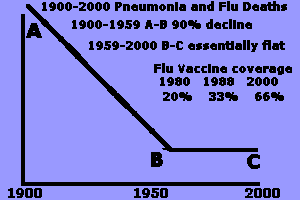 Flu Vaccine Increases Your Risk of the Flu
February 27, 2017 by Frank Shallenberger, MD Flu season is almost over. While the propaganda around the flu vaccine continues, the science behind the shots tells us how off the propaganda is. Let me warn you, if you're a fan of flu vaccines, you are probably not going to like what this new study has to say. The authors of the study were reporting specifically on the effectiveness of the flu vaccine in the years 2012 to 2015. To do the study, they looked at 1,930 men and women who came down with the flu during those years and how effectively the flu vaccine worked for them. Out of this group, 815 (42%) of them tested positive for the flu. Of these, 72% tested positive for influenza A and 28% for influenza B. According to the authors, "Virtually all influenza A cases involved the subtype virus known as H3N2." And they went on to report that the vaccine efficacy or VE for this virus was -16%. So, what exactly does that mean? Vaccine efficacy (VE) is the percentage of a reduction in a disease in a vaccinated group of people compared to an unvaccinated group. A VE of 100% would mean that the vaccine prevented the disease in 100% of those who got the vaccine. But what in the world does a negative VE like -16% mean? Believe it or not, it means that those men and women who had the vaccine were 16% more likely to get the flu than those who refused the vaccine. In other words, a negative VE is not a good thing for a vaccine to have. But hang on, there's more to talk about. For example, what happens to the flu vaccine VE if you get the vaccine year after year? Hold on to your hats. Read rest of story here: https://www.secondopinionnewsletter.com/Health-Alert-Archive/View-Archive/13750/Flu-Vaccine-Increases-Your-Risk-of-the-Flu-.htm
File# 8944flu.php
More info:A Perfect Storm: Impact of Genomic Variation and Serial Vaccination on Low Influenza Vaccine Effectiveness During the 2014–2015 Season https://pdfs.semanticscholar.org/8bc2/8f3fcc28cde84519019d6af98289f6c70465.pdf
August 15, 2012 Vaccines for preventing influenza in healthy children by Cochrane Summaries "The review authors found that in children aged from two years, nasal spray vaccines made from weakened influenza viruses were better at preventing illness caused by the influenza virus than injected vaccines made from the killed virus. Neither type was particularly good at preventing 'flu-like illness' caused by other types of viruses. In children under the age of two, the efficacy of inactivated vaccine was similar to placebo. It was not possible to analyse the safety of vaccines from the studies due to the lack of standardisation in the information given, but very little information was found on the safety of inactivated vaccines, the most commonly used vaccine in young children. [Editors note: Flu vaccine trials calculate "effectiveness" during, typically, a 6 month monitoring and "benefit" calculating period but the two week period following vaccination is not included in their calculations. Thus a vaccine that has more illness in the vaccinated group than the control group in 6-1/2 months following vaccination can show an alleged benefit by including only the 6 month period.] Read rest of Summary here: http://summaries.cochrane.org/CD004879/vaccines-for-preventing-influenza-in-healthy-children With Flu Season Over, Canada Shows Flu Vaccinations To Be Worse Than Worthless
May 17, 2010Last September, a large study by Canadian scientists Danuta Skowronski and Gaston De Serres threw Canada into an uproar with their findings showing people who had prior "seasonal flu" shots were much more likely to come down with newly appeared H1N1 (Swine) flu illness. When the dust had settled every Provincial Health Department but one, New Brunswick, declared seasonal flu shots would not be given until perhaps January of the new year, with only the new H1N1 vaccine immediately rushed into service. As it turned out by January first new flu cases had sunk to essentially zero so the seasonal flu shot became a moot point, having little appeal. All this was front page in newspapers across Canada, yet was completely ignored by the U.S. Health establishment and news media, illustrating the usual policy by officials at the the U.S. Centers for Disease Control (CDC) to keep the American public in the dark. In other words just follow orders from CDC Generals, don't ask questions, and in the immortal words of NBC's Dr. Nancy Snyderman on national TV, "just take your damn flu shot." Read rest of story here: http://www.ageofautism.com/2010/05/with-flu-season-over-canada-shows-flu-vaccinations-to-be-worse-than-worthless-.html More FluWatch Canada: http://www.phac-aspc.gc.ca/fluwatch/index-eng.php
Updated review questions benefits of flu vaccine in elderly Feb 18, 2010 (CIDRAP News) – In an updated analysis of scores of studies spanning four decades, researchers at the Cochrane Collaboration in Rome say reliable evidence on the effectiveness of influenza vaccination in elderly people is very sparse and shows only a modest benefit. ... The authors, led by Tom Jefferson, examined 75 studies and found that the vast majority were flawed by various kinds of selection biases, meaning the vaccinated and unvaccinated groups differed or might have differed in health status or other characteristics that may have affected the outcomes. The group found only one RCT that they regarded as fully reliable. For an excerpt and comment about the Cochrane Library research into Vaccines for preventing influenza in healthy adults see this link that provides a direct link to cochranejournalclub.com where free downloads of the Cochrane Database resources are available.
Flu shots futile: study Nursing Home Test; 'Didn't find' proof immunization stops virus A new Canadian-led study has added to a simmering scientific dispute over flu-shot campaigns, concluding that immunizing nursing-home workers does nothing to cut the number of confirmed influenza cases among the homes' elderly residents. "What troubled us is that [shots] had no effect on laboratory-confirmed influenza," said Dr. Roger Thomas of the University of Calgary, lead author of the paper published by the respected Cochrane Library. Read rest of story here:
Flu vaccines revealed as the greatest quackery ever pushed in the history of medicine October 14, 2009 http://www.naturalnews.com/027239_vaccine_flu_vaccines.html Thursday, October 11, 2007 Flu Shot Proven To Be Ineffective....Again. http://sayingnotovaccines.blogspot.com/ [Studies showing that healthy people die at a slower rate than unhealthy people have been used to make false claims that the flu vaccine saves many more lives than flu and pneumonia deaths combined.] [Vaccines cause Influenza Like Illness (ILI) but by not counting illness that occur right after vaccination, a false claim can be made that the vaccine prevents some clinically confirmed influenza cases.] The fact that the flu shots are ineffective in every age group hardly seems to matter to those who continually promote their use. Only a few studies of the vaccine have been conducted in children under 2 years old, and findings suggest that the injection is no better than a placebo at preventing influenza. Moreover, only one tiny study has looked specifically at the safety of flu shots in toddlers. The Cochrane review [The Cochrane Collaboration, an international organization that evaluates medical research.] comprised 51 studies of influenza vaccines — including 17 papers translated from Russian for the first time — involving more than 250,000 healthy youngsters under age 16. Yet only a fraction of these studies focused on children younger than 2. Two efficacy studies involving about 1,000 toddlers indicate that flu shots containing inactivated virus — the only vaccine approved for this age group — are no more effective at preventing the flu than placebo.
Center For Medical Consumers
In 2000 the Ontario Minister of Health and Long-Term Care launched a $38 million (annually) universal influenza immunization program for Ontario, Canada. Its objective was to decrease the seasonal impact of influenza on emergency department (ED) visits and to decrease the number and severity of influenza cases. A review of the efficacy of this program published in the Canadian Journal of Emergency Medicine found that the percentage of acute upper respiratory illnesses seeking emergency medical help is very low - "only 4.4% and of these influenza accounted for only 0.34%". Conclusion: “Based on this study, a universal influenza immunization campaign is unlikely to affect ED volume.” (6) [source VRAN] Vaccine Risk Awareness Network - - See sidebar for Influenza links.Many pages relating to Influenza in four main categories:
Influenza Links Flu Pandemic Flu Vaccine & Children Health Care Workers & Flu vaccines Good general information as well as info specific to Canada. Only a small percentage of reported cases of "Influenza-Like Illnesses" (ILI) are actually laboratory cofirmed as influenza virus - somewhere between 10-15%. The rest, 85% or more of ILI's are other identified as other viruses, RSV, rhinovirus, adenovirus, etc.
Time for the Flu Vaccine? Think Again The flu vaccine gets the most-useless-vaccine-of-all-time award. Now the CDC is recommending the vaccine for children under two years old and all adults over 50. Don't fall for it. ... Regardless of vaccination status, 99 percent of the elderly recover from the flu without being hospitalized.
Current URL of Canada's 'FluWatch' site: is http://www.phac-aspc.gc.ca/fluwatch/
CHICA-CANADA
The selection of reader comments on this article. (both pro and con - from protection to 'everybody gets the flu from the flu shot') is no longer posted on Health Canada's site so a copy of the comments is now posted HERE.
Of interest is the fact that a large percentage of the elderly that contracted the flu did so despite having had their flu shots. One nursing home in Toronto recorded 32 cases of the flu; of those who became ill, 31 had been vaccinated against the flu the month before.
"We have all heard of the Swine flu vaccine disaster of 1976 that left over 565 cases of Guillain-Barre Syndrome paralysis, as well as other neurological problems and many unexplained deaths among recently vaccinated elderly."
More Good Stuff
Vitamins Vitamin D proven far better than vaccines at preventing influenza infections Vitamin D3 supplement reduced ILI by 42 percent (8 % of group) http://www.naturalnews.com/029760_vitamin_D_influenza.html Vitamin D For Swine Flu Prevention by Dr. Soram Khalsa "I believe optimizing our Vitamin D blood levels is one of the best things we can do to protect ourselves from the Swine Flu." http://www.huffingtonpost.com/dr-soram-khalsa/vitamin-d-for-swine-flu-p_b_310235.html Flu Crimes at the CDC By Mark Sircus - International Medical Veritas Association CDC Flu Campaign - Exercise And Vitamins May Be More Effective Than Vaccinations http://www.laleva.org/eng/2004/10/
Basil and Vitamin D Think twice about that flu shot.... http://www.taxtyranny.ca/images/HTML
[Science? Or just a fancy explanation to cover the fact that vaccines always weaken the immune system? http://www.rice.edu/sallyport/2003/fall/sallyport/flu.html
Following links are general vaccination topics
Refusal/Legal: Return to Index of Articles for Vaccination Liberation.
Package Inserts: 2007-2008 FLU Vaccine Package Inserts: Name - Manufacturer Fluarix - GlaxoSmithKline | http://us.gsk.com/products/assets/us_fluarix.pdf FluMist - MedImmune | http://www.medimmune.com/pdf/products/flumist_pi.pdf http://www.novartisvaccines.com/products/15232_3_2007_FLVR_PI_LTR_L5.pdf Fluvirin - Novartis Vaccine (formerly Chiron Corp.) Fluzone - sanofi pasteur | http://www.vaccineshoppe.com/US_PDF/Fluzone_2006.2007_7.06.pdf FluLaval - GlaxoSmithKline |OK'ed October 5, 2006 for adults. http://www.fda.gov/cber/label/flulavalLB.pdf [2007-2008 Package Insert] Beautiful Quote: " FLULAVAL is an influenza virus vaccine indicated for active immunization of adults 18 years of age and older against influenza disease caused by influenza virus subtypes A and type B contained in the vaccine. (1) This indication is based on immune response elicited by FLULAVAL, and there have been no controlled trials demonstrating a decrease in influenza disease after vaccination with FLULAVAL. (14) FluMist Package Inserts: PDR Drug information for Flumist Vaccine http://www.drugs.com/PDR/Flumist_Vaccine.html http://www.flumist.com/pdf/prescribinginfo.pdf 2007-2008 Formula http://www.medimmune.com/pdf/products/flumist_pi.pdf 2007-2008 Formula Package Inserts and Manufacturers for some US Licensed Vaccines and Immunoglobulins [GENERAL vaccines, not just flu] http://www.vaccinesafety.edu/package_inserts.htm
ARCHIVED - Package Inserts: file:///home/du/vaclib.org/basic/fluindex.htm#science
Following four links for 2005 package inserts was taken from: http://www.cdc.gov/flu/professionals/ [begin quote]" Influenza Vaccine Package Inserts For details about influenza vaccines being produced by the four manufacturers licensed in the United States, consult their package inserts at the following links:
Source for the Package insert for Fluzone 'preservative free' 2002-2003 Formula. https://www.vaccineshoppe.com/US_PDF/ If you dont want to download this 132K .PDF file, here are a few highlights: [original is 8 pages]
Highlights of http://www.vaccineinfo.net/immunization/ | |||
|
The following data is from National Center for Health Statistics (CDC/NCHS) Yearly Mortality (USA) Note the low yearly figures for Flu associated deaths taken alone! | |||
|---|---|---|---|
| Year | Influenza | Pneumonia | Notes: |
| 2002 | 727 | 64,954 | nvsr53_05.pdf infant =4, age 1-4=7 deaths |
| 2001 | 257 | 61,777 | nvsr52_13.pdf rate=0.1/100,000 |
| 1999 | 572 | 49,954 | Page 58 (10th Revision numbers) |
|
Great graph of the number of Influenza Deaths as tabulated by CDC and found on American Lung Association site.
http://poisonevercure.150m.com/diseases/influenza3.htm CDC table archived at: www.lungusa.org/atf/cf/%7B7A8D42C2-FCCA-4604-8ADE-7F5D5E762256%7D/PI1.PDF
INFLUENZA The following note posted at http://poisonevercure.150m.com/diseases/influenza3.htm may explain the difference: "The large decrease in Influenza deaths from 2000 to 2001 is largely due to a change in the coding rules, which resulted in deaths that would have previously been assigned to Influenza, instead were assigned to Pneumonia in 2001." -page 104
http://www.cdc.gov/nchs/data/nvsr
which shows for the years 1979-1998, combined pneumonia and influenza deaths:
"Over the past twenty years, age specific death rates for pneumonia
and influenza have increased in the older adult populations (65+
years), and decreased in the childhood population (0-14 years),
and have remained relatively constant in other population subgroups.
The national data indicate a significant rise in the age specific
pneumonia and influenza death rates among people 85 years and
older.
"Source: NCHS, 2000a,b; NCHS 1999. Rates are age adjusted to the
1940 US population.
Nationally, death rates from pneumonia and influenza have
remained relatively constant since the 1980s (approximately
12-13 deaths per 100,000 population). ..."
[for a population of 280 million X 12/100k = 33,600 deaths. (combined flu & pneumonia)]
In the time period that death rates from flu increased in the
older sub-population,
the following pro vaccine -short course- thoughtfuly informs us that
the vaccination rates also increased!
http://www.nursingceu.com/NCEU/courses/influenza/
[Fortunately, in what way, for whom? Could it be the vaccines are worthless??? ]
See our section below on graphs and scroll down for a table and links to better estimates (by the CDC) of the actual number of deaths associated with the flu versus the much larger number of flu and pneumonia combined.
2000: The National Center for Health Statistics (NCHS), a branch of the CDC knew that "Over the past twenty years, age specific death rates for pneumonia and influenza have increased in the older adult populations..." at the same time as flu vaccination rates also increased. (A)
In October of 2002, this information was posted at: http://www.vaclib.org/basic/fluindex.htm .
February 2005: Study conducted by NIH funded by National Vaccine Program published showing flu vaccine is worthless in preventing deaths amoung elderly. (B)
Still the NIH and CDC continue to recommend a worthless procedure.
(A) http://mainelung.org/learn_with_us/lhi2/fluG2.html
(B)The following quotes are from
http://www.nelh.nhs.uk/hth/flu_vaccine.asp
Where does the evidence come from?
"The coverage of flu vaccination increased from 16% to 65% over the study period." [1968-2001]
Reference: February 15, 2005:
Reference:
This is not to mention the portion of the bioterrorism preparedness program which is devoted in some way to vaccines.
| |||